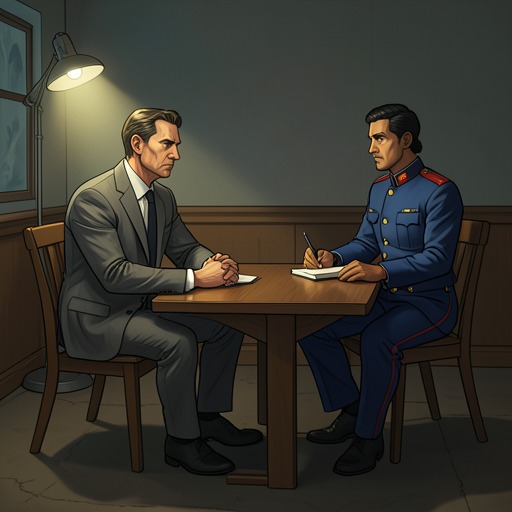
The Watchman swallows an egg and dies by suicide
The SympathizerThe Watchman swallows an egg and dies by suicide after a week of good behavior in custody, turning an ordinary breakfast into a final act of resistance. His death follows an interrogation in which The unnamed narrator helped break him and showed him his confession; its immediate aftermath unsettles the narrator’s sense of time, memory, and his own identity.
Interrogation and the week before his death
The Watchman had learned what the Americans taught but rejected those teachings, and The unnamed narrator had come to identify with the Americans’ position as he interrogated him. The narrator’s satisfaction at The Watchman’s expense seemed to confirm his success as a student of Claude’s methods. After the narrator showed The Watchman his confession, The Watchman behaved well for a week. The guards rewarded this conduct with the breakfast he wanted: hard-boiled eggs.
The suicide thus follows a confession that The Watchman did not accept as the end of the struggle. The narrator had believed he had broken him; The Watchman’s last action reverses that judgment, making the prisoner the one who outmaneuvers his interrogator. The death also belongs to a wider system of interrogation at the National Interrogation Center, where coercion could be hidden behind official routines and euphemistic rooms. Here, however, the decisive instrument is not an elaborate technique but the food granted as a reward.
The death at the National Interrogation Center
A guard from the surveillance room called The unnamed narrator one morning. By the time the narrator reached the National Interrogation Center, Claude was already there. The Watchman lay curled on a white bed, facing a white wall, dressed in white shorts and a T-shirt. When they rolled him over, his face was purple, his eyes bulging, and a white lump visible deep in his open mouth.
The guard had stepped away briefly while The Watchman ate. He had peeled and swallowed the first two eggs, then choked himself by swallowing the third whole, shell and all. The sequence makes the death startlingly matter-of-fact: the guard had left for the bathroom, and the meal that marked The Watchman’s good behavior became the means of his death. Claude ordered the guard to turn off the music. The command could not restore the ordinary rhythm of the room; it only marked the silence that followed.
Aftermath and narrative significance
The unnamed narrator later realizes that time had stopped for him as well as for The Watchman. In his recollection, he sees the other white room with unnerving clarity from his own white room, as if watching himself and Claude through a camera in the corner. Claude reassures him that he had not thought of this possibility either. The narrator says nothing; the smell of sulfur drives other thoughts from his mind, leaving him to repeat inwardly that he is not a bastard, then to doubt the claim.
The death therefore becomes more than the conclusion of an interrogation. It punctures the narrator’s confidence in his role as a successful pupil and breaks his experience of time into the witnessed scene and the later room from which he remembers it. The Watchman’s final act also gives concrete force to the narrator’s reflection that a person can sabotage a system of representation that claims ownership over him: the confession has been produced, but it cannot contain or finally control the meaning of The Watchman’s resistance.